🎯 There's No "Better" Blockchain — Only the Right Tool for Each Job
The debate: "Ethereum or Solana?" sounds like asking "cars or airplanes?" — both move you forward, but they're designed for completely different purposes. Ethereum prioritizes security and decentralization. Solana prioritizes speed and cost. Understanding why requires looking under the hood at their cryptographic DNA.
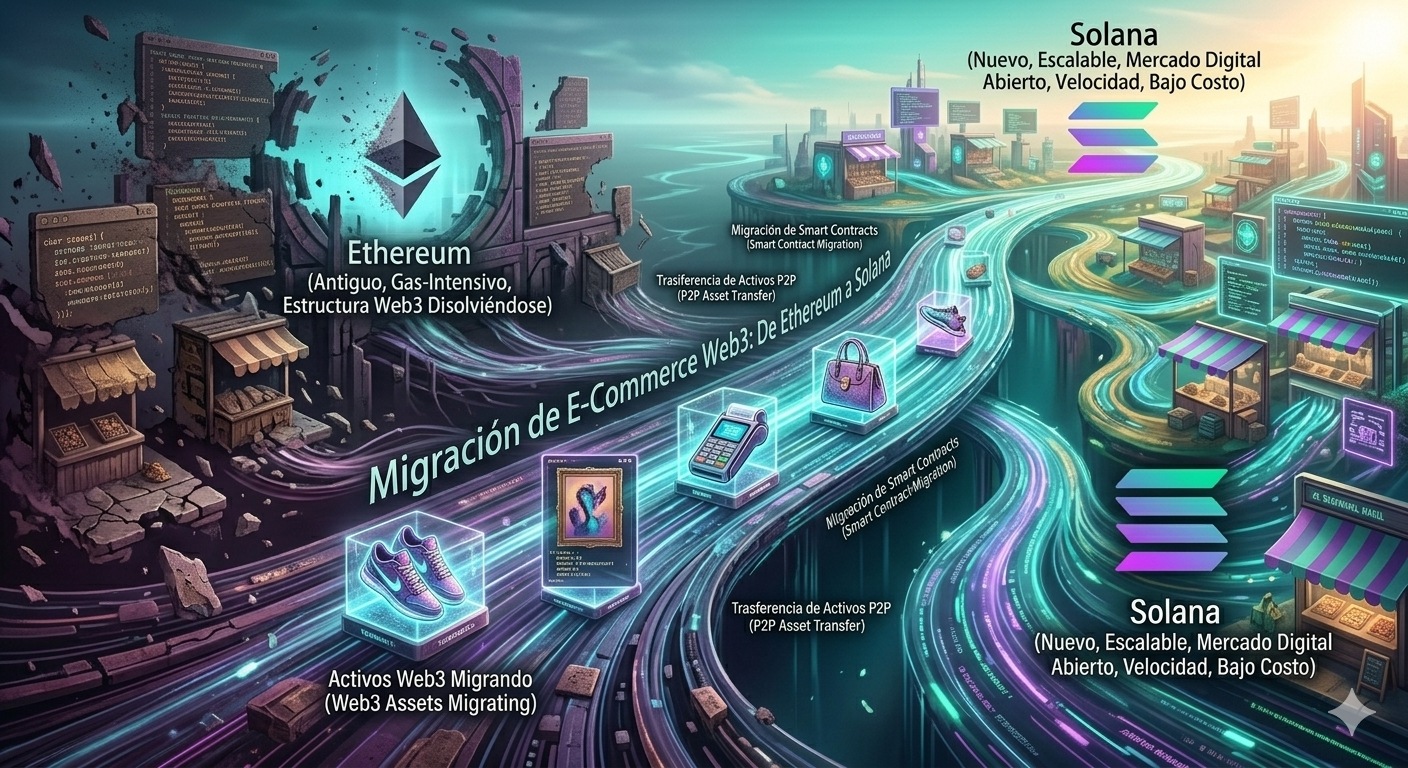
Technical subtitle: EVM monolithic state vs Solana stateless programs with Sealevel parallelism and Ed25519 cryptography
📊 The Fundamental Question: What Should a Blockchain Prioritize?
Every blockchain makes trade-offs. You can't maximize everything simultaneously.
| Priority | Ethereum's Approach | Solana's Approach |
|---|---|---|
| Security | Maximum — sequential processing, unified state | High — but requires validator hardware investment |
| Decentralization | High — lower hardware barriers | Moderate — validators need powerful servers |
| Speed | ~15-30 TPS (base layer) | ~65,000 TPS theoretical |
| Cost | Volatile ($0.50 - $50+ per tx) | Predictable (~$0.001 per tx) |
| Developer Experience | Intuitive — code + data together | Complex — stateless programs, explicit accounts |
flowchart TD
    subgraph Design_Spectrum
        A[Security First] --- B[Balanced] --- C[Speed First]
    end

    Ethereum["Ethereum<br/>Security + Decentralization"] --> A
    Solana["Solana<br/>Speed + Cost Efficiency"] --> C

    style Ethereum fill:#fff3e0,stroke:#ffa000,stroke-width:3px
    style Solana fill:#e0f7ff,stroke:#00f2ff,stroke-width:3px
The insight: Neither is "better." They're optimized for different workloads. Ethereum is a secure settlement layer. Solana is a high-performance execution engine.
1. The Network DNA: Cryptography at the Core
Every blockchain needs cryptography to create accounts, sign transactions, and prevent fraud. Ethereum and Solana chose different cryptographic systems — and those choices ripple through everything.
Ethereum: The Reliable Classic (secp256k1 + Keccak-256)
Ethereum uses the same elliptic curve as Bitcoin: secp256k1. Your private key generates a public key, which is then "blended" through Keccak-256 (a hash function) to create your address.
Why this matters: Your Ethereum address is a truncated hash of your public key. It's 20 bytes (40 hex characters) and always starts with 0x. This has been the standard since Bitcoin — battle-tested, widely supported.
Solana: The Speed Machine (Ed25519)
Solana chose Ed25519 — an elliptic curve designed for verification speed.
| Property | secp256k1 (Ethereum) | Ed25519 (Solana) |
|---|---|---|
| Key size | 256 bits | 256 bits |
| Signature size | 65 bytes | 64 bytes |
| Verification speed | ~1-2ms | ~0.2-0.5ms |
| Address format | 0x + 40 hex chars (20 bytes) | Base58, ~34-38 chars (32 bytes) |
| Security model | Proven since 2009 | Resistant to timing attacks |
Why Ed25519 matters for Solana: When you're processing thousands of transactions per second, every millisecond of signature verification adds up. Ed25519 is 5-10x faster to verify than secp256k1.
flowchart LR
    subgraph Ethereum_Crypto
        SK1[Private Key] --> EC1[secp256k1]
        EC1 --> PK1[Public Key]
        PK1 --> HASH[Keccak-256]
        HASH --> ADDR1[0x...20 bytes]
    end

    subgraph Solana_Crypto
        SK2[Private Key] --> EC2[Ed25519]
        EC2 --> PK2[Public Key]
        PK2 --> BASE58[Base58 encoding]
        BASE58 --> ADDR2[~34 chars, 32 bytes]
    end

    style Ethereum_Crypto fill:#fff3e0,stroke:#ffa000
    style Solana_Crypto fill:#e0f7ff,stroke:#00f2ff
2. The Account Model: Where Does Data Live?
This is where Ethereum and Solana diverge most dramatically.
Ethereum: The "World Computer" (Code + Data Together)
In Ethereum, a smart contract is like a self-contained computer. Code and data live in the same account:
The mental model: Each contract is an object with its own memory. This is intuitive for programmers coming from traditional languages.
Solana: The "Operating System" (Code + Data Separated)
In Solana, programs are stateless. They contain logic but no data. Everything lives in accounts — independent data files:
The mental model: Programs are functions. Accounts are files. The program reads and writes files passed to it by the client.
graph TB
    subgraph EVM_Contract
        C[Contract Account] --> CODE[Code + Logic]
        C --> DATA[State + Data]
        CODE --> DATA
    end

    subgraph Solana_Model
        P[Program Account - Stateless]
        A1[Account: From Balance]
        A2[Account: To Balance]
        A3[Account: Token Mint]
        P -->|Reads/Writes| A1
        P -->|Reads/Writes| A2
        P -->|Reads/Writes| A3
    end

    style EVM_Contract fill:#fff3e0,stroke:#ffa000
    style Solana_Model fill:#e0f7ff,stroke:#00f2ff
PDAs: Solana's "Magic" Addresses
Since programs can't store data, how does Solana handle ownership? Enter PDAs (Program Derived Addresses) — addresses derived deterministically from seeds, with no private key:
The program can "sign" transactions from a PDA because the address is mathematically derived from the program's identity. No human key needed.
3. Processing: The War for Speed
Ethereum: Single Processor (Sequential)
Ethereum processes one transaction at a time within a block. The entire network maintains a single global state.
The bottleneck: If 100 people want to interact with the same contract, they queue up. Each waits for the previous one to complete. During high demand, gas fees spike because users bid for priority.
Solana: Thousand Processors (Parallel)
Solana's Sealevel engine processes transactions in parallel — as long as they touch different accounts.
The advantage: If users are interacting with different tokens, different PDAs, different accounts — everything happens simultaneously.
Proof of History: The Cryptographic Clock
Solana adds PoH — not a consensus mechanism, but a verifiable timestamp:
flowchart LR
    A[Hash Chain] --> B[Hash 1 + Timestamp 1]
    B --> C[Hash 2 + Timestamp 2]
    C --> D[Hash 3 + Timestamp 3]
    D --> E[Verifiable Delay Function]
    E --> F["Transactions ordered without node communication"]

    style F fill:#ccffcc,stroke:#00aa00
PoH is like a metronome that hashes continuously, creating a mathematical clock. Transactions are ordered by when they appear in the hash chain — nodes don't need to communicate to agree on time.
4. Strengths and Weaknesses: The Trade-Offs
🔷 Ethereum
| Strengths | Weaknesses |
|---|---|
| Developer simplicity — Code + data together is intuitive | Sequential processing — Limited to ~15-30 TPS base layer |
| Security & decentralization — Lower hardware barriers for validators | Gas volatility — Fees can spike to $50+ during congestion |
| Network effect — Largest DeFi ecosystem, most developers | Layer 2 dependency — Scaling requires Rollups (added complexity) |
🟣 Solana
| Strengths | Weaknesses |
|---|---|
| Speed — Thousands of TPS with sub-second finality | Learning curve — PDAs, stateless programs, explicit account passing |
| Cost — Fractions of a cent per transaction | Hardware barriers — Validators need expensive, powerful servers |
| Parallel execution — Sealevel engine processes independent tx simultaneously | Complexity — Client must track and pass all accounts per transaction |
🤔 Which One Should You Use?
| Use Case | Recommended Chain | Why |
|---|---|---|
| High-value settlements | Ethereum L2 (Arbitrum, Optimism) | Security and auditability |
| E-Commerce | Solana | Speed + low fees enable real transactions |
| DeFi protocols | Ethereum (L1) + L2s | Liquidity depth and security |
| Gaming | Solana | Fast, cheap transactions per player action |
| NFT marketplaces | Both — Ethereum for premium, Solana for volume | Different market segments |
| Institutional RWAs | Solana | Predictable costs, high throughput |
✅ Key Takeaways
- Architecture dictates possibilities: Ethereum's sequential model enables simplicity and security. Solana's parallel model enables speed and scale.
- Cryptography choices compound: Ed25519's speed enables Solana's throughput. Keccak-256's maturity enables Ethereum's security.
- The future is multi-architecture: Different blockchains will serve different workloads. The winners will be those that match architecture to use case.
Want to explore the cryptography deeper? Check out my technical notes in github.com/87maxi/jupyter — Python notebooks analyzing cryptographic systems, elliptic curves, and digital signatures.
📊 Key Metrics
| Metric | Ethereum | Solana |
|---|---|---|
| Cryptography | secp256k1 + Keccak-256 | Ed25519 |
| Signature Verification | ~100 sigs/sec (single thread) | ~100,000 sigs/sec (batch) |
| Transaction Finality | ~12-30 seconds (L1) | ~1 second |
| Transaction Cost | $1 - $50+ | ~$0.0001 |
| Execution Model | Sequential (EVM) | Parallel (Sealevel) |
| Account Model | Code + Data together | Code + Data separated |
🔗 Continuous Learning
- Solana Docs: Cryptography — Ed25519 signature verification at scale
- Ethereum Yellow Paper — Formal specification of EVM
- Solana Whitepaper — Technical architecture of Proof of History
- secp256k1 vs Ed25519 — Cryptographic curve comparison
- Jupyter Cryptography Notebooks — Python implementations of cryptographic systems
🤝 Contribute
This article compares two blockchain architectures that I've implemented in practice. If you have insights on:
- Cryptographic primitives — Elliptic curves, hash functions, digital signatures
- Blockchain architecture — EVM, WasmVM, Sealevel, or alternative runtimes
- Multi-chain development — Cross-chain communication, bridges, interoperability
...your contribution is welcome:
- 🐛 Report issues: github.com/87maxi/jupyter/issues
- 🔧 Pull Requests: Welcome for new cryptographic implementations
- 💡 Discussions: Open a discussion to share architecture comparisons
🔗 Related Articles
- Migración Solidity → Anchor — From EVM monolithic state to Solana programs
- Introducción: El reto de los RWA — Why Solana for institutional tokenization
- Master en Blockchain: 8 Proyectos — Complete project retrospective